Find the use case and prove it
Before any build we check which problems are worth solving with AI and whether your data can support them, then prove the approach on a small scale.
Discuss it with us[00] AI & ML Development
We build AI and machine learning systems that solve one business problem at a time, such as forecasting demand, reading documents or spotting fraud. Each starts from your own data and ends as a model running inside the software your team already uses, with its accuracy measured.
Illustration: five everyday inputs (a photo of a supplier invoice, a WhatsApp reorder message, a voice note about a damaged order, a photo of a damaged delivery and an email with a purchase order PDF) are read one by one. Images get boxes around the vendor, totals or damage, and text gets its names, dates, quantities and intent highlighted. The fields fill a structured record that is sent to the ERP, CRM or helpdesk, and items the AI is unsure about go to a person for review.
What we deliver
Our work covers the whole range of applied AI: classic machine learning on tables of business data, deep learning for images, speech and video, natural language processing, and generative AI built on large language models such as GPT, Claude, Gemini and Llama. We choose the simplest approach that meets the target, not the most fashionable one.
Around the models we do the engineering that keeps them useful: data pipelines, integration with ERP, CRM and mobile apps, MLOps for versioning and monitoring, and retraining as your data changes. You can engage us for a fixed-scope project or a dedicated team of ML engineers and data scientists.
Before any build we check which problems are worth solving with AI and whether your data can support them, then prove the approach on a small scale.
Discuss it with usWe review your processes and data, rank use cases by value and effort, and tell you plainly which ones are not ready for AI yet.
A small working model on a sample of your real data, with an agreed accuracy target, so you can decide before committing a full budget.
Machine learning on your business records and deep learning on images and video, trained and tested on your own data.
Discuss it with usClassification, regression and forecasting for demand, churn, credit risk, fraud and predictive maintenance, trained on your own history.
Image classification, object detection, OCR and visual quality inspection, tested on photos and video from your own cameras and production lines.
Language models that understand documents and conversations, and agents that take the next step in your systems.
Discuss it with usText classification, entity extraction, summarisation, sentiment analysis, translation and search across contracts, emails, tickets and reports.
Assistants, document automation and knowledge search built on GPT, Claude, Gemini or Llama, grounded in your documents through retrieval-augmented generation (RAG).
Multilingual chatbots and agents that answer questions, update records and route work across support, sales and HR, handing over to a person when needed.
Pipelines that feed models clean data, and deployment, monitoring and retraining so accuracy holds after launch.
Discuss it with usPipelines, ETL and ELT jobs, warehouses and data lakes that collect and clean the data your models depend on, and keep it flowing after launch.
Docker and Kubernetes deployment, MLflow or Kubeflow experiment tracking, monitoring and retraining, plus APIs into your ERP, CRM and apps.
which approach fits
Not every problem needs deep learning or a large language model. We match the approach to the problem and the data you have, and say so when a rule or a report will do.
Forecast a number or score a risk: demand, churn, credit or late payments
data it learns from: Historical records from your ERP, CRM or databases
we usually start with: Classic machine learning, such as gradient-boosted trees, tested against a simple baseline
Machine learning developmentSort, route or pull fields out of emails, tickets and documents
data it learns from: Examples of the documents, some with the right answers
we usually start with: A language model with clear instructions first; a trained NLP model when volumes are high or the rules are strict
LLM developmentInspect, count or recognise things in photos and video
data it learns from: Labelled images from your own cameras or production lines
we usually start with: Deep learning computer vision, adapted from a pre-trained model
Computer vision developmentAnswer questions from your policies, manuals and contracts
data it learns from: The documents themselves; no training set needed
we usually start with: A language model with retrieval (RAG) that cites its sources
RAG vs fine-tuningCarry out multi-step tasks across your systems
data it learns from: Access to the systems' APIs, plus your rules and approval limits
we usually start with: An AI agent, with a person approving any costly or irreversible step
AI agent developmentApply a fixed rule that never changes
data it learns from: None
we usually start with: Plain software, a report or an RPA bot. No model needed, and we will tell you so.
Robotic process automationWhy it matters
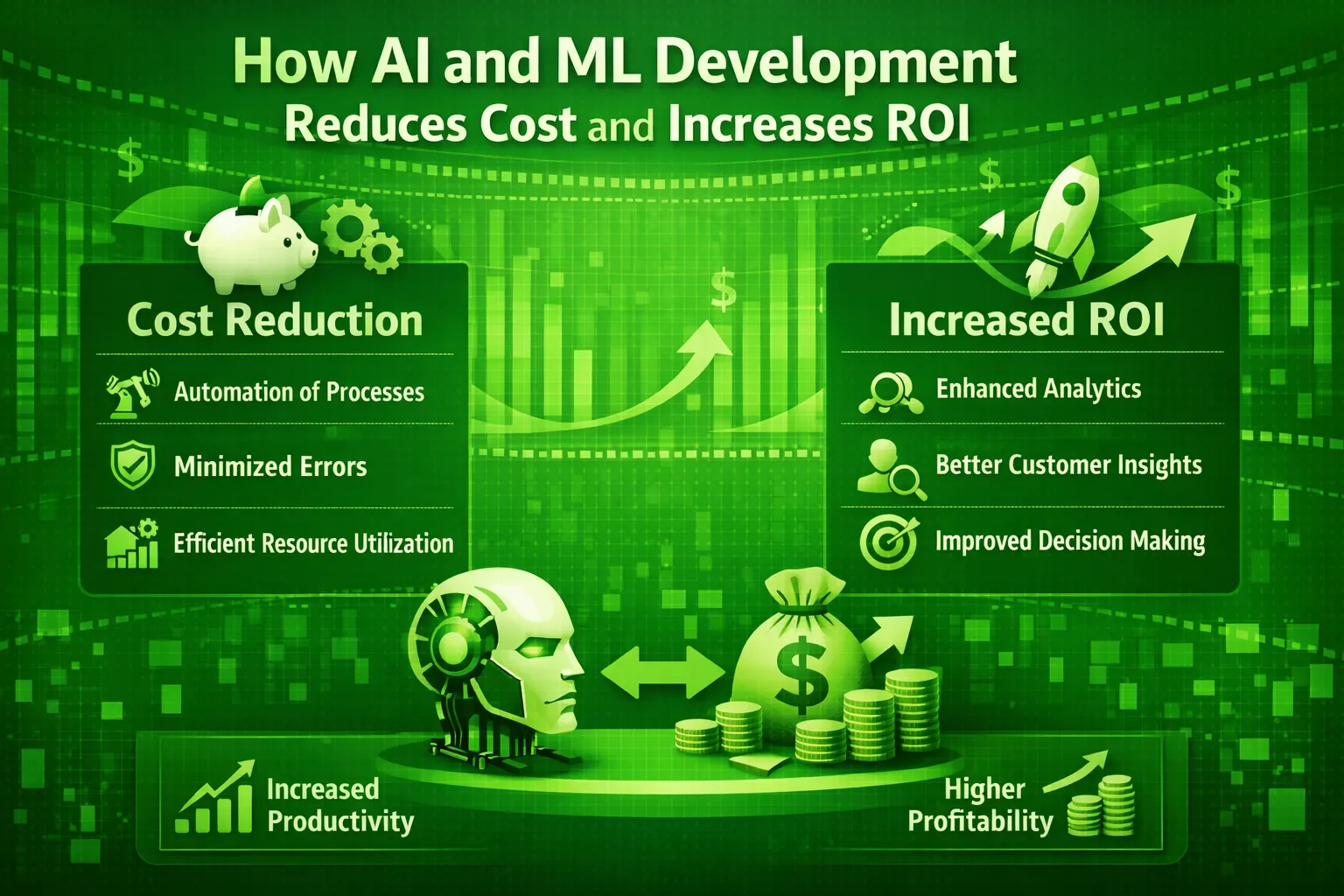
AI & ML Development is planned around these outcomes, measured against a baseline we agree with you up front.
Discuss your projectDocuments, tickets and approvals that staff now read and key in by hand can be classified, extracted and routed for a person to check.
Models trained on your own history give demand, risk and churn estimates that planners can act on, with the uncertainty shown alongside.
The same team handles data preparation, modelling, integration and support, so nothing is lost between a consultant's report and a working system.
A measured proof of concept comes first, so a full build is funded only once the pilot has shown it works on your data.
results
From our published case study.
input the challenge
Manual, repetitive processes, high operating costs, little data to base decisions on and systems that could not keep up with growth.
output what we delivered
AI automation and RPA for rule-based work, workflow automation across departments and real-time analytics, rolled out in four phases.
source: enterprise with complex operational workflows case study
How we work
A clear five-step process, so you always know what happens next and what you will get.
Every project starts with a free, no-obligation consultation.
$ appsinai run --pilot-first
We agree one business problem, how success will be measured and which data exists to learn from, and check that the data can support the target.
you get use-case ranking · data review · success measure · fixed quote
we need a walkthrough of the process · data samples · one decision-maker
We clean and prepare the data, compare approaches from simple baselines to deep learning or an LLM, and test the strongest on held-back data it never saw in training. The results are reviewed with your team against the agreed target.
you get working model · evaluation report · go / no-go
we need access to the data · a domain expert for questions
We deploy to your cloud or servers and connect the model to the systems where people work, with access controls, logging and human review where a wrong prediction would be costly.
you get production model · apis and integrations · tested release
we need test access to your systems · sign-off at each milestone
Your team learns to use the predictions on real cases, then we roll out in stages and stay close through the first weeks.
you get team training · documentation · staged rollout
we need a first group of users
Accuracy, drift and usage are tracked after launch, and models are retrained as your data and business change.
you get drift monitoring · retraining · support plan
we need feedback on wrong predictions
↺ results feed the next improvement cycle$
Security & control
AI projects need access to business data. Before work starts we agree in writing which data is used, where it lives and who can reach it.
Ask us about securityModels and data can run in your own cloud account, in the region you choose, or on your servers, so data does not need to leave your environment.
Role-based access, encryption in storage and in transit, and secure APIs. Our engineers get only the access the project needs, removed at handover.
Where we use hosted LLM APIs, we configure the options that keep your prompts and files out of the provider's training data, or use an open-source model you host.
We sign an NDA before you share any data. Once the project is paid for, the code and models we build are yours, as set out in the contract.
FAQ
Straight answers to what buyers ask us most. Can't find what you need?
Email sales@appsin.ai or call +91-9025555584.
Ask us directlyIt depends on the problem, how much data preparation is needed, whether an existing model can be adapted or a new one must be trained, the number of integrations and where it is hosted. A proof of concept costs a fraction of a full build. After a requirements review you get a fixed quote for the agreed scope.
Estimate your AI project costA proof of concept typically takes 3 to 6 weeks. A full custom solution typically takes 2 to 6 months, and large enterprise platforms take longer. Most of the variation comes from data preparation and the number of systems the model has to connect to.
We agree the accuracy target before any build and measure the proof of concept against it on data the model has never seen. If it falls short, we explain why, whether that is too little data, noisy labels or a problem framed too broadly, and what would close the gap: more or better data, a narrower scope, or a person reviewing the uncertain cases. If none of those is worth it, we recommend stopping, and you have spent only the proof-of-concept budget.
No. We bring the machine learning engineers and data scientists. From your side we need someone who knows the process and can make decisions, and someone in IT who can give access to systems and data. We document everything and train your team, so an in-house team can take over later if you build one.
Python with scikit-learn, PyTorch and TensorFlow for custom models; GPT, Claude, Gemini, Llama and Mistral for language tasks; MLflow or Kubeflow, Docker and Kubernetes for deployment; and AWS, Azure, Google Cloud or your own servers for hosting. We pick per project by testing candidates on your data, not by habit.
Models and tools we useIt depends on the use case. It can be database records, documents, images, video, sensor readings or public datasets. You do not need perfectly clean data on day one: preparing and cleaning it is part of our work, and the feasibility review tells you whether there is enough to learn from.
If a ready-made tool already handles your task well, use it. Custom work makes sense when your data, process or accuracy needs are specific to your business, or when the AI has to sit inside your own systems. We often combine both, for example a hosted LLM with your own retrieval and rules.
Custom AI vs off-the-shelfYes. We connect models to ERP, CRM, accounting, e-commerce, mobile and custom systems through their APIs, webhooks or data exports, and return results into the screens your team already uses.
You do. On completion and final payment, the code, prompts, trained or fine-tuned models and documentation we build for you are handed over, as set out in the contract. Third-party and open-source models stay under their own licences.
Monitoring, performance tuning, model retraining, security updates, bug fixes, infrastructure management and new features, under a support plan agreed at handover.
Free PDF brochure
Features, outcomes, delivery process and FAQs in one PDF you can share with your team or management.
Your download should start automatically. If not, use the button.
related
Free consultation
Book a free 30-minute call. Tell us the process or decision you want to improve and we will tell you honestly whether AI fits, what data it needs and what a proof of concept would involve.