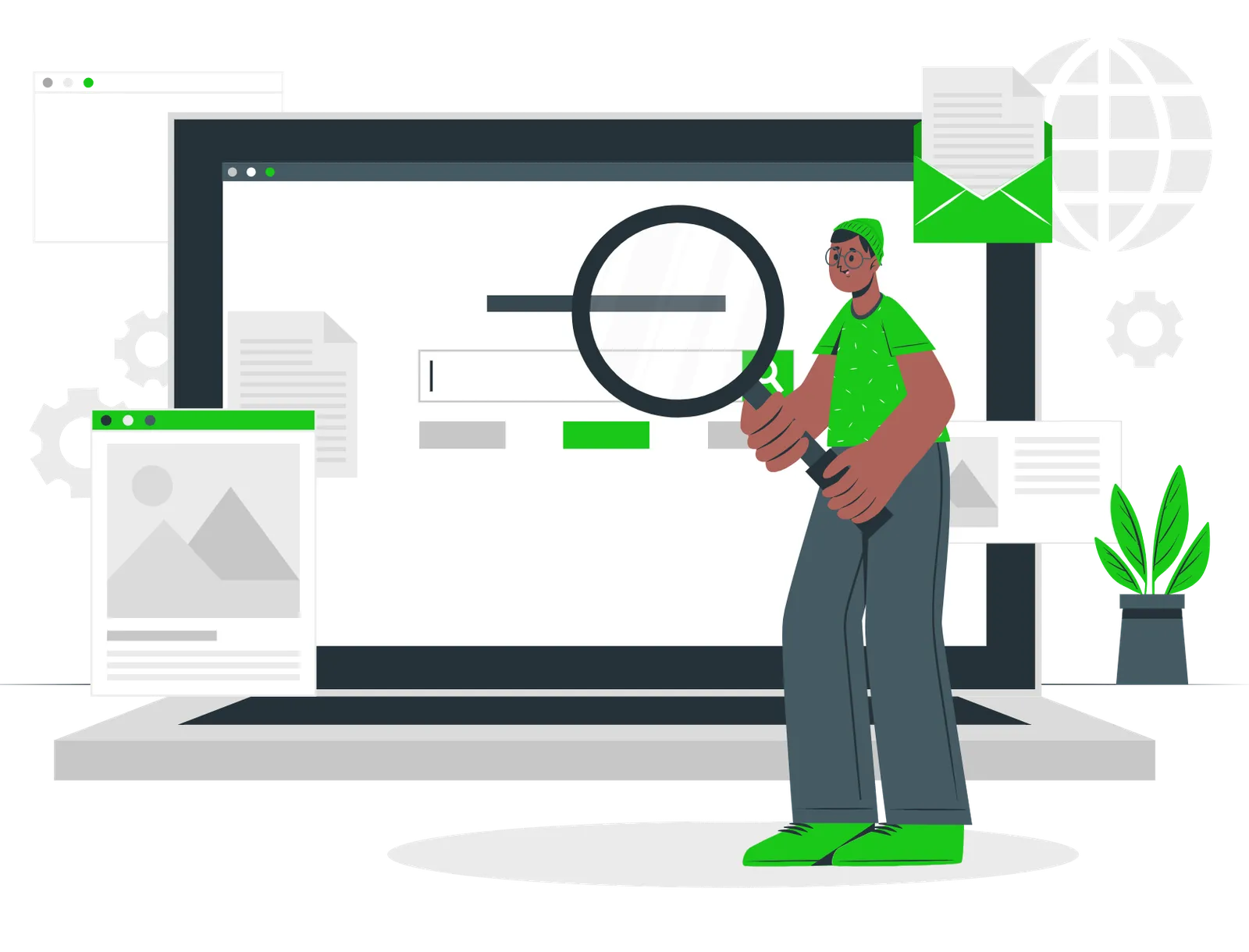
Decide what to collect, and from where
Each source is checked against its robots.txt, terms and APIs before anything is built, and the research questions are pinned down first.
Discuss it with us[00] Web Scraping & Data Collection
We build web scraping and data collection pipelines that turn public web pages into structured data you can use: product prices and availability, property and job listings, public directories, news, tenders and market information. Data is cleaned, de-duplicated and delivered as CSV, JSON or XML, or loaded straight into your database or CRM.
Illustration: five public web pages (a product page, a property listing, a tender notice, a job listing and a news article) are read one by one. The product name, price, location, closing date and other fields are highlighted on each page and fill a structured record, which is delivered as a CSV file, to a database, an API, a JSON feed or a CRM. A closing date in an unclear format is sent to a person for review.
What we deliver
We scrape responsibly. Before building anything, we check each site's robots.txt and terms of use, whether an official API or data licence exists, and whether the data includes personal information. We collect publicly available data only, never get past logins, paywalls or CAPTCHAs, and keep request rates low so we do not burden the sites we visit.
Where pages are messy, we combine scrapers with AI and machine learning to extract fields from free text, and add human review where accuracy matters. Scrapers are monitored and maintained, because websites change and a silent failure is worse than no data.
Each source is checked against its robots.txt, terms and APIs before anything is built, and the research questions are pinned down first.
Discuss it with usFor each site we check robots.txt, the terms of use and whether an API or licensed feed exists, and flag any personal data before collection starts.
Targeted research on markets, competitors and customer segments from public online sources, compiled into a structured data set.
Fields pulled from static and JavaScript pages on a schedule, with AI for free text and a record of what changed since the last run.
Discuss it with usPrices, product details, listings, directories, reviews and news turned into consistent fields that match the schema you need.
Pages that load content with JavaScript are read with headless browsers, within the same rules on access, rate and public data.
Daily, weekly or hourly runs that record what changed since the last visit, such as a new price, a sold listing or an updated tender.
Language models and machine learning pull fields out of free text and tag records into schema-compliant output, with checks and sampled human review.
De-duplicated, standardised records delivered to your storage, API or database, with analysis on top when you need it.
Discuss it with usDuplicates removed, units, currencies and dates standardised, and records matched across sources, so the data is ready for analysis.
Files by SFTP or cloud storage, a simple API, or direct loads into your relational database, CRM or CMS on each run.
Clustering, classification and trend analysis on the collected data, so you receive patterns and forecasts as well as raw records.
source check
For each site on your list we read robots.txt and the terms of use, look for an official API or data feed, and check for personal data. Only sources that pass get a scraper. The rest get a better route.
Is web scraping legal?shop.example/products
wants: prices · stock
robots.txt: ✓allowed
terms of use: ✓no ban
official API: –none
personal data: ✓none
verdict: scrape
daily · 1 request every 5 s
market.example/listings
wants: listings · prices
robots.txt: ✓allowed
terms of use: !API preferred
official API: ✓public API
personal data: ✓none
verdict: use the API
more stable, clearly allowed
homes.example/agents
wants: listings · agents
robots.txt: ✓allowed
terms of use: ✓no ban
official API: –none
personal data: !names, phones
verdict: scrape, skip people
listing fields only
fares.example/prices
wants: fares
robots.txt: ✗disallowed
terms of use: ✗bans bots
official API: –none
personal data: ✓none
verdict: do not scrape
ask the owner for a data licence
trade.example/members
wants: supplier directory
robots.txt: ✓allowed
terms of use: ✗login required
official API: –none
personal data: !member details
verdict: do not scrape
behind a login: data agreement instead
2 sources scraped · 1 through its API · 2 need another route
Why it matters
Web Scraping & Data Collection is planned around these outcomes, measured against a baseline we agree with you up front.
Discuss your projectScheduled runs keep prices, listings and market data up to date without anyone copying pages by hand.
Clean, consistent fields arrive ready for your spreadsheets, dashboards or models, with no reformatting.
The same pipeline grows from a handful of sources to thousands, with monitoring that shows which source failed and why.
Compliance checks, polite crawling and minimal personal data keep collection within the rules and away from complaints.
How we work
A clear five-step process, so you always know what happens next and what you will get.
Every project starts with a free, no-obligation consultation.
$ appsinai run --pilot-first
We agree your business objectives, the exact fields you need, how often you need them and the list of candidate sources.
you get data schema · source list · delivery plan
we need the fields you need and how often · your list of candidate sources
Each source is reviewed for robots.txt rules, terms of use, API alternatives and personal data. Sources that do not pass are dropped or replaced.
you get verdict per source · api or licence alternatives · fixed quote
we need your legal contact for borderline sources
Scrapers are built with rate limits, retries and validation rules, then run on a sample so you can check the output against the schema.
you get sample data set · validation report · go / no-go
we need your check of the sample data
Runs happen on schedule, data is cleaned and checked, and alerts tell us when a site changes or a run returns unusual results.
you get scheduled deliveries · change log per run · failure alerts
we need a destination: storage, an api or your database
Data is delivered in your format and destination, and scrapers are updated as sites change, for as long as you need the feed.
you get scraper updates · run reports · new sources on request
we need notice of new fields or sources
↺ results feed the next improvement cycle$
Security & control
Responsible scraping protects you as much as the sites you collect from. These rules apply to every project, whatever the source.
Ask us about securityWe collect only publicly available pages, follow robots.txt and site terms, and never get past logins, paywalls or CAPTCHAs.
Low request rates, off-peak scheduling, caching and automatic back-off on errors keep our load on any site small.
We avoid collecting personal data. Where a project needs it, it must have a lawful basis under laws such as the GDPR and India's DPDP Act, and is minimised or pseudonymised.
Data is encrypted in transit and storage, delivered only to your systems, and kept no longer than the retention period you set.
where this fits
Web data is rarely the end goal. Collected rows can go straight into labelling, analysis and dashboards, and each of those is a service you can hire with us or on its own.
Exports from your own systems, plus public or partner sources gathered into clean, structured rows.
People tag text, images and records to an agreed guide, and a second reviewer checks the hard cases.
We clean and profile the data, find what actually predicts the outcome and spot gaps before anything is built on it.
Dashboards your managers will open, showing the numbers the work is meant to move.
FAQ
Straight answers to what buyers ask us most. Can't find what you need?
Email sales@appsin.ai or call +91-9025555584.
Ask us directlyIt depends on what is collected, how and where. Collecting public, non-personal data at a reasonable rate while respecting a site's terms is generally lower risk. Getting past logins, ignoring terms, copying copyrighted content or collecting personal data raises legal questions under laws such as the CFAA in the USA, the GDPR in the EU and India's DPDP Act. This is not legal advice, so for sensitive projects we recommend checking with your own lawyer.
Read: Is web scraping legal?Yes. We check robots.txt and the terms of use for every source before building a scraper. If a site disallows the pages you need or prohibits automated collection, we look for an official API, a data licence or another source instead.
No. We do not bypass logins, paywalls, CAPTCHAs or other access controls. If the data sits behind an account, the right route is an API or a data agreement with the site owner, which we can help you integrate.
We avoid it by default and design scrapers to skip fields such as names, emails and phone numbers. If personal data is genuinely needed, the project must have a lawful basis under the GDPR, India's DPDP Act or the laws that apply to you, and we minimise, pseudonymise and secure what is kept.
CSV, Excel, JSON or tagged XML files, a simple API, or direct loads into your relational database, CRM or CMS. We agree the schema with you first, so every delivery has the same fields.
Scrapers can break when a site changes. Every run is validated, and alerts tell us when a source returns missing or unusual data, so we can fix the scraper rather than deliver bad data quietly.
If the site offers an official API or data feed that covers what you need, usually yes. It is more stable and clearly permitted. We check for one during discovery and only scrape where no suitable alternative exists.
Discovery and the source check take one to two weeks, and a pilot sample usually follows within one to three weeks, depending on the number of sources and how complex the pages are. Scheduled deliveries start once you approve the sample.
It depends on the number of sources, how complex the pages are, how often data is collected and how much cleaning it needs. Building the scrapers is a fixed price after the source check, and keeping them running is a monthly plan.
Estimate your project costFree PDF brochure
Features, outcomes, delivery process and FAQs in one PDF you can share with your team or management.
Your download should start automatically. If not, use the button.
related
Free consultation
Share the fields, sources and frequency you have in mind. We will check what can be collected responsibly and propose a pipeline with a fixed quote.