
The right method and the right data
We test prompting and retrieval before training, and build the dataset that decides the result when training is worth it.
Discuss it with us[00] Model Training & Fine-Tuning
A general-purpose model knows a lot about everything and little about your business. Fine-tuning trains it further on your own examples, so it uses your terminology, follows your formats and handles your edge cases. We run the whole job, from dataset to deployment.
built for
Illustration: a fine-tuning console cycling through three example runs. A support-reply model whose scores on a test set climb past a prompt-only baseline, an insurance intent classifier whose confusion matrix sharpens onto the diagonal, and an invoice extraction model whose field accuracy beats the baseline. Training and validation loss curves draw in, sample outputs flip from wrong to right, training stops early when validation loss stops improving, and each run ends with a saved checkpoint ready for pilot review. All values are demo values.
What we deliver
Fine-tuning is not always the first step. Many problems are solved with better prompts or with retrieval over your documents, at lower cost and with easier updates. We start by testing those options against a baseline, and recommend training only where it clearly beats them on your own test set.
When training is the right choice, the dataset decides the result. Most of the effort goes into collecting, cleaning and labelling examples. We then train with parameter-efficient methods where possible, and check the tuned model for accuracy, safety and any loss of general ability before it goes live.
We test prompting and retrieval before training, and build the dataset that decides the result when training is worth it.
Discuss it with usWe review your goal, data and budget, then choose between prompting, RAG, fine-tuning or training a model from scratch.
Structured instructions, worked examples and iterative prompt refinement to improve consistency and reduce hallucinations before any training.
Collecting, cleaning, de-duplicating and labelling prompt-response pairs or classified examples, with a held-out set kept back for testing.
Supervised fine-tuning for format and behaviour, preference tuning for judgement, and small task-specific models for speed and cost.
Discuss it with usFull or LoRA and QLoRA fine-tuning of open-source models, or managed fine-tuning of hosted models where the provider offers it.
Aligning outputs with what your reviewers prefer, using ranked examples and methods such as DPO, so tone and judgement match your standards.
Smaller models trained for one job, such as classification, sentiment analysis or field extraction, that run fast and cheaply at volume.
Retrieval for current facts, red-team testing before release, and versioned deployment so any earlier model is one step away.
Discuss it with usPairing a tuned model with retrieval, so it writes in your style while drawing facts from your current documents.
Adversarial prompts, bias checks and safety thresholds that catch harmful, biased or off-policy outputs before release.
Tuned models served in your software, website or chat platform, with versioning so you can return to an earlier model at any time.
which approach fits
Training is the most expensive way to change a model's behaviour, and not always the most effective. We match the fix to what is actually wrong, and test cheaper options first on your own examples.
Gets facts wrong or out of date
what you have: Current documents and records
the right fix: Retrieval (RAG), not fine-tuning: facts change, and retrieval keeps up
RAG vs fine-tuningIgnores your format or instructions now and then
what you have: A clear spec and a few examples
the right fix: Better prompts, worked examples and structured output first
Prompt engineering, explainedNeeds your tone, format or judgement every time
what you have: A few hundred good, checked examples
the right fix: Supervised fine-tuning, usually with LoRA so only a small part of the model changes
LoRA, explainedShould prefer the answers your reviewers prefer
what you have: Pairs of better and worse answers, ranked by your team
the right fix: Preference tuning, using methods such as DPO
Is too slow or costly at your volume
what you have: Outputs from a larger model, or labelled examples
the right fix: A smaller task-specific model, distilled or fine-tuned for one job
Distillation, explainedHas to run on your own servers
what you have: An open-weight model whose licence allows your use
the right fix: Fine-tune the open-weight model and host it in your environment
Open-weight models, explainedAlready meets your standard with good prompts
what you have: A test set that shows it
the right fix: Keep it as it is. No training needed, and we will tell you so.
data first
Most fine-tuning problems are data problems. Before we train anything we collect the right examples, label them carefully, check what they can and cannot tell us, and agree how the result will be measured. Each step is a data service you can also hire on its own; the last one, BI, tracks the result after launch.
Exports from your own systems, plus public or partner sources gathered into clean, structured rows.
People tag text, images and records to an agreed guide, and a second reviewer checks the hard cases.
We clean and profile the data, find what actually predicts the outcome and spot gaps before anything is built on it.
Dashboards your managers will open, showing the numbers the work is meant to move.
dataset.cardexample
splits · example ratio
A dataset card records where the examples came from, how they were reviewed and how they were split, so anyone can check what the model learned from.
Why it matters
Model Training & Fine-Tuning is planned around these outcomes, measured against a baseline we agree with you up front.
Discuss your projectA tuned model follows your structure, field names and house style every time, without a page of instructions in each prompt.
A small tuned model can replace long prompts sent to a large one, using fewer tokens per request. We measure the trade-off before you switch.
Building on a pre-trained model needs far fewer examples and much less GPU time than training a model from nothing.
Every training run is scored against the same held-out set, so you see exactly what improved and what got worse.
How we work
A clear five-step process, so you always know what happens next and what you will get.
Every project starts with a free, no-obligation consultation.
$ appsinai run --pilot-first
We define the task, agree the metric and measure how a strong base model with good prompts performs today.
you get agreed metric · baseline score · recommended method · fixed quote
we need sample inputs and the outputs you expect · one decision-maker
Examples are drawn from your records or written with your experts, then cleaned, labelled and split into training and test sets.
you get cleaned dataset · labelling guide · held-out test set
we need past records or examples · experts to check labels
We pick the base model and method, then train, freezing or adapting layers as the task needs, and track every run.
you get tracked training runs · model checkpoints
we need a cloud account or servers to train in
The tuned model is compared with the baseline on the held-out set, checked for lost general skills and red-teamed for safety.
you get comparison report · safety test results · go / no-go
we need reviewers for a sample of outputs
We integrate the model, monitor its output and retrain with new examples when your products, policies or language change.
you get served model · version rollback · retraining
we need new examples as your business changes
↺ results feed the next improvement cycle$
Security & control
A fine-tuning dataset is a concentrated copy of your know-how. We keep it, and the model trained on it, under your control.
Ask us about securityJobs run in your cloud account or on your servers where possible, so datasets and checkpoints stay in your environment and region.
Before using a provider's managed fine-tuning, we confirm its data terms, including that your data is not used to train its other models.
Names, ID numbers and other personal details are stripped or masked from training examples unless the task needs them and you approve.
On completion and final payment, the curated dataset, training configuration and tuned weights are handed over, as set out in the contract. We sign an NDA before you share any data.
FAQ
Straight answers to what buyers ask us most. Can't find what you need?
Email sales@appsin.ai or call +91-9025555584.
Ask us directlyTraining builds a model from scratch on a very large dataset, which takes heavy compute and time. Fine-tuning starts from a model that is already trained and continues training on a smaller, task-specific dataset. It is a form of transfer learning, and it is what most business projects need.
Fine-tune when you need consistent formats, a specific tone, specialised behaviour or lower cost per request, and prompting has stopped improving results. Use RAG when the model needs facts that change often or must cite sources. The two work well together.
Read RAG vs fine-tuningLess than most people expect, but it must be good. A focused task can often be improved with a few hundred carefully checked examples, while broader behaviour needs more. A small pilot run on part of your data shows whether adding more examples is likely to help.
Fine-tuning can technically run on CPUs, but GPUs make it practical. A single run on a smaller model may take minutes to hours, depending on model size, dataset and hardware. Most of a project's calendar time goes on preparing data and evaluating results, not on the training itself.
It is when a model over-adapts to a narrow dataset and loses general skills it had before. We limit it with parameter-efficient methods that change only a small part of the model, careful learning rates, mixing in general examples, and testing general ability alongside the target task.
How much data has to be collected and labelled, the size of the base model, the number of training and evaluation rounds, GPU time, and how the model will be hosted. Data preparation is usually the largest share.
Estimate a fine-tuning projectYou do. On completion and final payment, the dataset we prepare and the tuned weights are handed over, as set out in the contract. The base model stays under its original licence, so we check that licence permits your intended commercial use before training starts. Models tuned through a provider's managed service stay in your account with that provider.
Both. Some providers, including OpenAI, offer managed fine-tuning for selected models, and the tuned model then runs in your account with that provider. Open-weight models such as Llama and Mistral can be tuned with LoRA or fully and hosted wherever you choose. Which models a provider lets you tune changes over time, so we check current options at the start.
Facts that change belong in retrieval, not in the weights, so most updates need no retraining. When behaviour should change, for example a new product line or a new policy, we add examples, retrain and compare the new version with the current one on the same test set before switching. Every version is kept, so you can roll back.
Free PDF brochure
Features, outcomes, delivery process and FAQs in one PDF you can share with your team or management.
Your download should start automatically. If not, use the button.
related
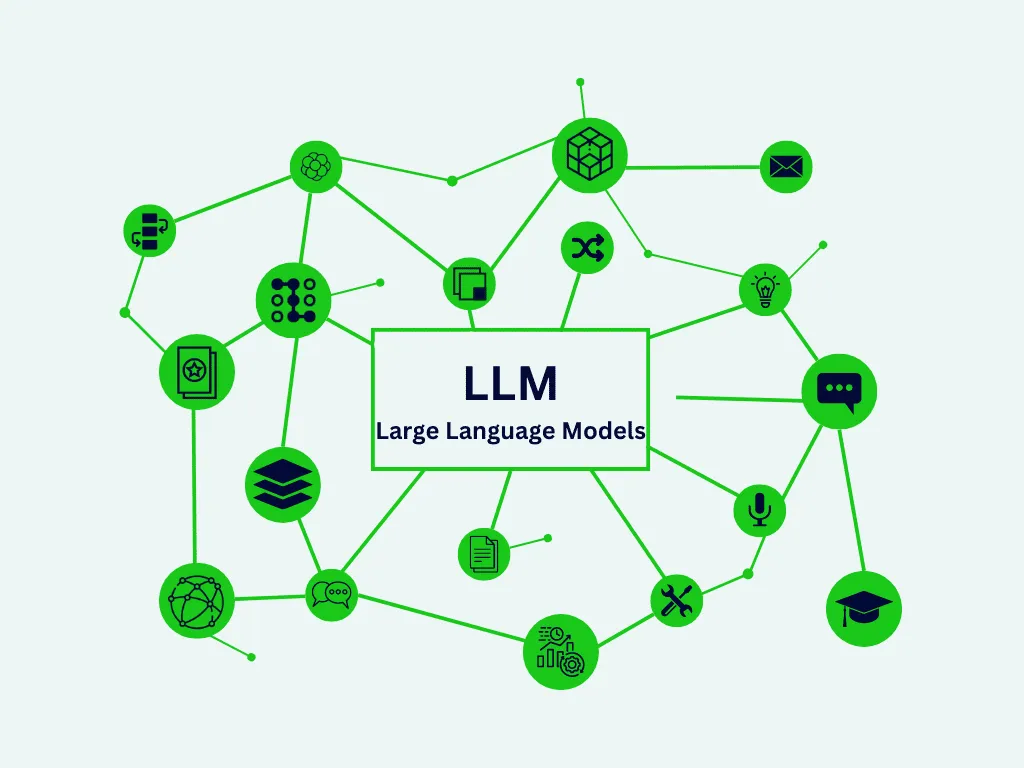 14 Jun 2024 · 6 min readAn Introduction to Large Language Models: What You Need to Know
 2 Apr 2026 · 7 min readIndustries Transformed by Large Language Models (LLMs) in 2026: Use Cases, Trends & Enterprise Impact
 27 Mar 2026 · 16 min readAI/ML Development Services: A Strategic Investment Guide for CEOs & CTOs
Free consultation
Send us a sample of the task and the outputs you expect. We will compare prompting, RAG and fine-tuning on it and recommend the cheapest option that meets your standard.