[00] Article
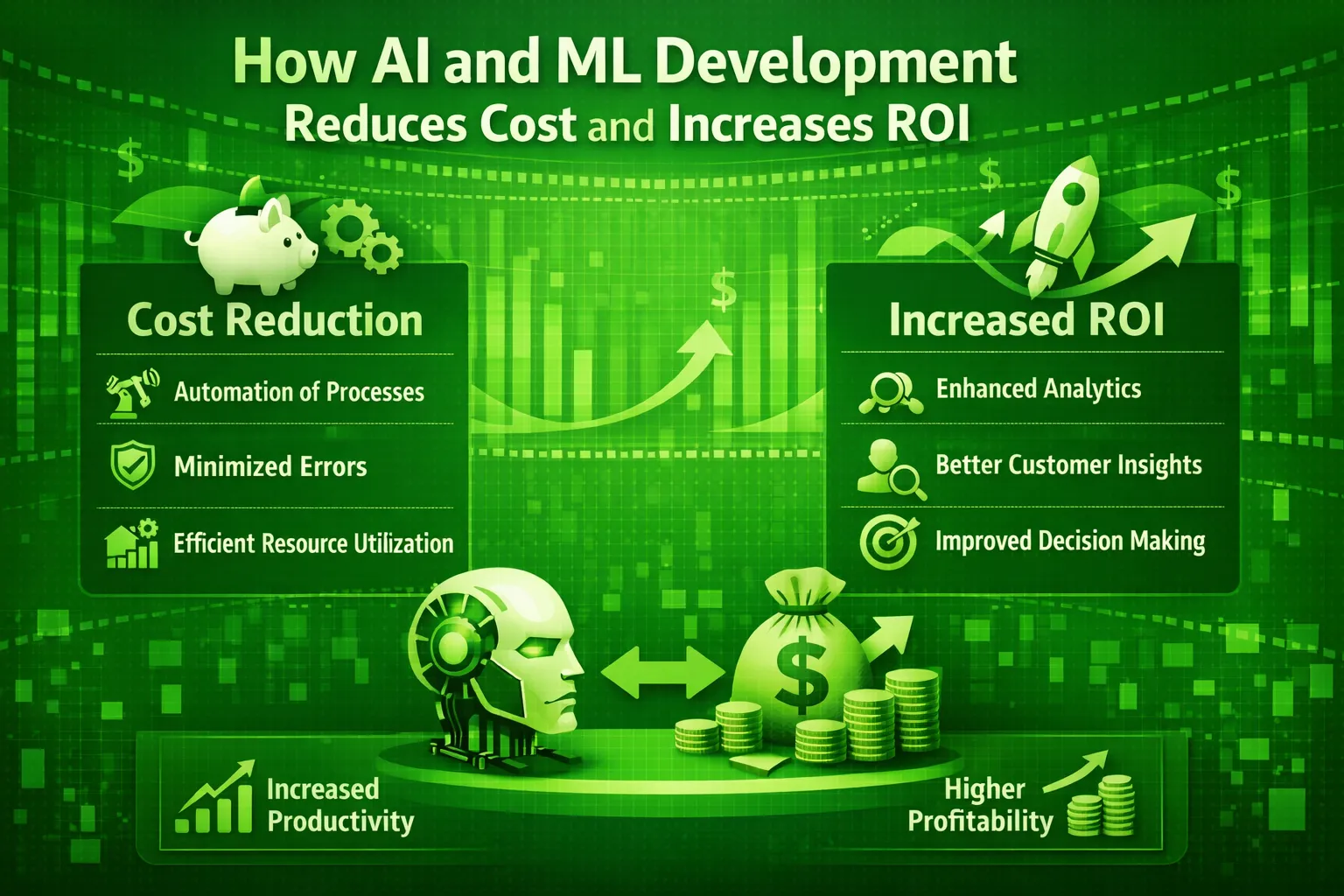
How AI and ML Development Reduces Cost and Increases ROI
Discover how AI and ML development reduces operational costs, improves efficiency, and increases ROI for startups and enterprises.
by AppsInAidate read 5 minupdated
on this page11
- 01What Is AI and ML Development?
- 02How AI and ML Reduce Operational Costs
- 03How AI and ML Increase ROI
- 04AI vs Traditional Automation: Cost & ROI Comparison
- 05Industry-Specific AI ROI Examples
- 06AI Implementation Cost vs Long-Term Value
- 07How Startups and Enterprises Benefit Differently
- 08Common Myths About AI Cost & ROI
- 09How to Maximize ROI from AI & ML Development
- 10Future of AI ROI in 2026 and Beyond
- 11Final Thoughts: AI Is the Smartest Investment You Can Make
In today’s hyper-competitive digital economy, businesses are under constant pressure to reduce costs, improve efficiency, and maximize return on investment (ROI). Traditional cost-cutting methods – downsizing, outsourcing, or manual optimization – are no longer sustainable.
This is where Artificial Intelligence (AI) and Machine Learning (ML) come into play.
AI and ML development is not just about futuristic technology. It’s about real, measurable business outcomes:
- Lower operational expenses
- Faster decision-making
- Smarter resource allocation
- Scalable growth without proportional cost increases
Organizations that invest in AI early consistently outperform competitors in profitability, agility, and customer satisfaction.
What Is AI and ML Development?
Artificial Intelligence (AI)
AI enables machines to simulate human intelligence -thinking, learning, problem-solving, and decision-making.
Machine Learning (ML)
ML is a subset of AI that allows systems to learn from data and improve automatically without being explicitly programmed.
AI & ML Development Includes:
- Predictive analytics
- Natural Language Processing (NLP)
- Computer vision
- Recommendation engines
- Intelligent automation
- AI chatbots & virtual assistants
- Fraud detection systems
How AI and ML Reduce Operational Costs
1. Automation of Repetitive Tasks
One of the biggest cost drains in any organization is manual, repetitive work.
AI-powered automation can handle:
- Data entry
- Invoice processing
- Customer support queries
- Report generation
- Employee onboarding
Cost Impact:
- Significantly reduces labor costs
- Eliminates human errors
- Operates 24/7 without overtime costs
2. Predictive Maintenance Cuts Downtime Costs
Traditional maintenance is reactive – fixing problems after they occur.
AI-driven predictive maintenance:
- Analyzes sensor data
- Predicts failures before they happen
- Schedules maintenance only when needed
Cost Impact:
- Lowers maintenance costs
- Minimizes equipment downtime
- Extends asset lifespan
Industries benefiting the most:
- Manufacturing
- Automotive
- Logistics
- Energy
3. Smarter Resource Allocation
AI analyzes historical and real-time data to:
- Forecast demand
- Optimize staffing
- Reduce inventory waste
- Balance workloads
Cost Impact:
- Lower inventory holding costs
- Reduced overstaffing or understaffing
- Improved operational efficiency
AI ensures you spend exactly where it matters.
4. Reduced Human Errors
Human errors are expensive – especially in finance, healthcare, and logistics.
AI systems:
- Validate data automatically
- Detect anomalies
- Ensure compliance
Cost Impact:
- Fewer compliance penalties
- Reduced rework and corrections
- Higher accuracy at scale
How AI and ML Increase ROI
Reducing costs is only half the story. AI truly shines when it amplifies revenue and ROI.
1. Data-Driven Decision Making
AI processes massive datasets faster than humans ever could.
AI-powered insights help businesses:
- Identify profitable opportunities
- Optimize pricing strategies
- Reduce risk
ROI Impact:
- Faster decisions
- Higher success rates
- Improved strategic planning
Companies that use AI analytics well often see a strong return within the first 12–18 months.
2. Personalized Customer Experiences
AI analyzes user behavior to deliver:
- Personalized product recommendations
- Dynamic pricing
- Customized marketing campaigns
ROI Impact:
- Higher conversion rates
- Increased customer lifetime value
- Improved brand loyalty
3. AI-Driven Sales and Marketing Optimization
AI transforms marketing from guesswork into precision.
AI helps with:
- Lead scoring
- Campaign optimization
- Predictive customer targeting
- Marketing spend optimization
ROI Impact:
- Lower customer acquisition cost (CAC)
- Higher marketing ROI
- Better conversion rates
4. Faster Time-to-Market
AI accelerates:
- Product development
- Testing
- Deployment
- Feedback analysis
ROI Impact:
- Faster innovation cycles
- Competitive advantage
- Increased revenue opportunities
Speed = money in modern markets.
AI vs Traditional Automation: Cost & ROI Comparison
Factor | Traditional Automation | AI & ML Development |
Scalability | Limited | Highly scalable |
Learning Capability | Static | Self-improving |
Error Handling | Rule-based | Intelligent |
Long-Term ROI | Moderate | Exponential |
Adaptability | Low | High |
Industry-Specific AI ROI Examples
Healthcare
AI diagnostics reduce misdiagnosis costs
Automated patient scheduling lowers admin expenses
Predictive analytics improve treatment outcomes
Retail & E-commerce
AI demand forecasting reduces overstock
Recommendation engines increase AOV
Chatbots reduce support costs
Manufacturing
Predictive maintenance lowers downtime
Quality inspection via computer vision
Supply chain optimization
Finance
Fraud detection saves millions
AI credit scoring improves loan ROI
Automated compliance monitoring
AI Implementation Cost vs Long-Term Value
Initial AI Development Costs Include:
- Data preparation
- Model training
- Infrastructure
- Integration
Why ROI Still Wins:
- One-time investment
- Continuous optimization
- Minimal incremental costs
- Scales without proportional hiring
How Startups and Enterprises Benefit Differently
Startups
Faster scaling with lean teams
Lower operational overhead
Smarter go-to-market strategies
Enterprises
Process optimization at scale
Legacy system modernization
Global operational efficiency
AI adapts to both growth stages.
Common Myths About AI Cost & ROI
Myth 1: AI Is Too Expensive
Reality: Modular AI solutions make adoption affordable.
Myth 2: ROI Takes Years
Reality: Many companies see ROI within 6–12 months.
Myth 3: AI Replaces Humans
Reality: AI augments human productivity, not replaces it.
How to Maximize ROI from AI & ML Development
Start with high-impact use cases
Ensure quality data
Choose the right AI development company
Focus on scalable solutions
Measure ROI continuously
Future of AI ROI in 2026 and Beyond
Beyond 2026:
- AI-driven companies will dominate markets
- Manual operations will become cost liabilities
- ROI will depend on intelligent automation
Frequently Asked Questions
How does AI reduce business costs?
AI automates repetitive tasks, minimizes errors, predicts failures, and optimizes resources – significantly lowering operational expenses.
How does machine learning increase ROI?
Machine learning improves decision accuracy, personalization, forecasting, and efficiency, leading to higher revenue and lower costs.
Is AI worth the investment for small businesses?
Yes. Scalable AI solutions allow small businesses to achieve enterprise-level efficiency at affordable costs.
When can businesses expect ROI from AI?
Most organizations see measurable ROI within 6 to 18 months, depending on implementation scope.
Final Thoughts: AI Is the Smartest Investment You Can Make
AI and ML development is no longer about experimentation – it’s about profitability, efficiency, and long-term growth.
Businesses that embrace AI today:
- Spend less
- Earn more
- Scale faster
- Compete smarter
Those who delay will pay the price in higher costs and lost opportunities.