

Multimodal AI Model: Applications, Benefits, Architecture & Future
- Author: Arun Kumar
- Posted On: August 13, 2026
- Post Comments: 0
| Getting your Trinity Audio player ready... |
Table of Contents
ToggleArtificial intelligence is moving beyond text-only interactions. Modern AI systems can understand images, interpret speech, analyze video, process documents, and combine information from multiple sources to generate context-aware responses.
A multimodal AI model brings these capabilities together within a unified AI system. Instead of treating text, images, audio, and video as completely separate inputs, multimodal AI can connect information across different modalities to understand a situation more comprehensively.
For businesses, this creates opportunities to build intelligent applications that can see, hear, read, reason, and generate content within the same workflow.
From visual quality inspection and healthcare document analysis to intelligent customer support, retail personalization, financial document processing, and AI-powered assistants, multimodal technology is becoming an important part of enterprise AI strategies.
This guide explores what a multimodal AI model is, how it works, its architecture, applications, benefits, challenges, and how businesses can implement multimodal generative AI models effectively.
What Is a Multimodal AI Model?
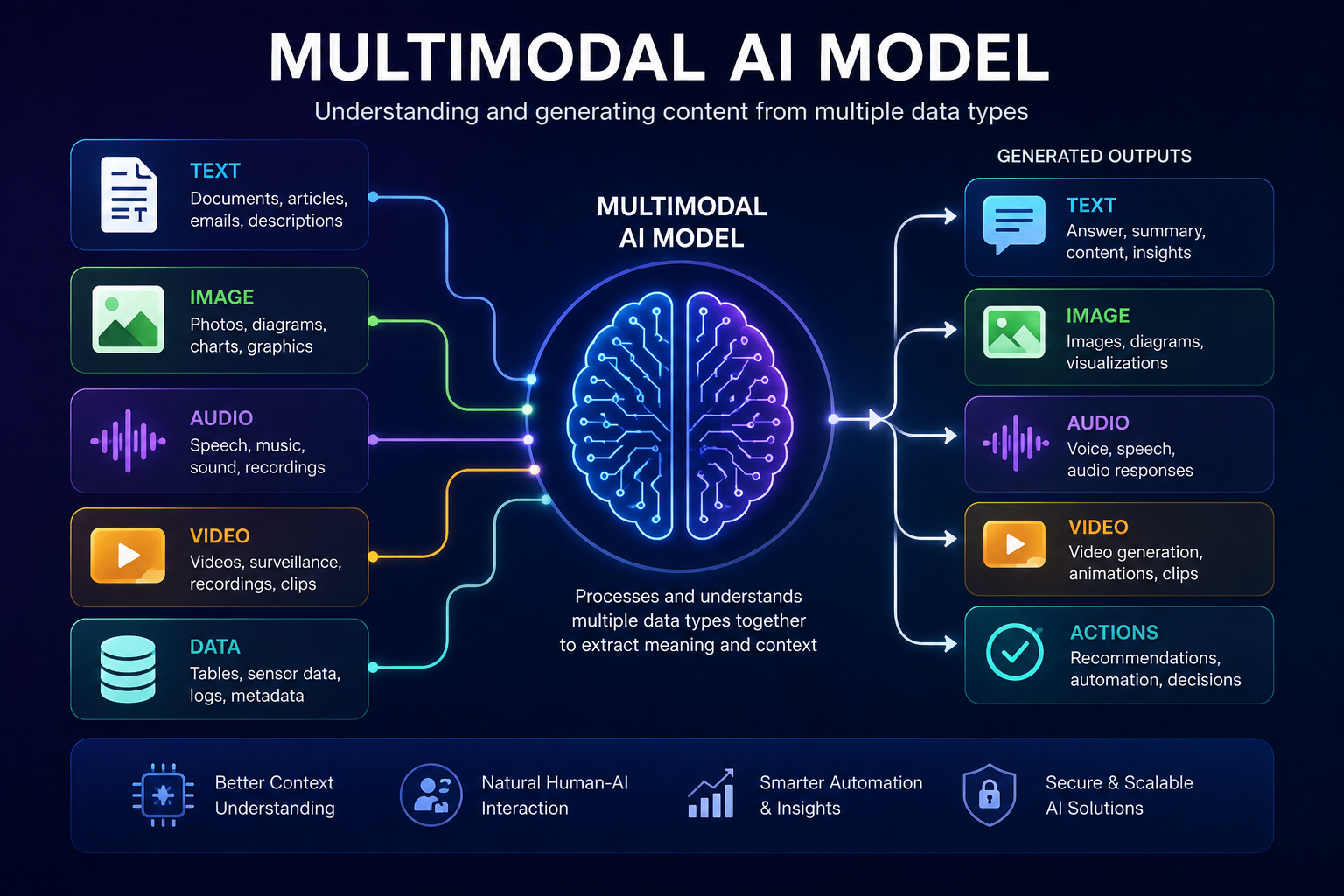
A multimodal AI model is an artificial intelligence system designed to process and understand information from multiple data modalities, such as text, images, audio, video, documents, and structured data.
Traditional AI systems are often designed around a specific type of input. A text-based model primarily understands language, while a computer vision model focuses on visual information.
Multimodal AI combines these capabilities so that an application can reason across different forms of information.
For example, a customer could upload:
A product photograph
A voice recording explaining the problem
A purchase invoice
A written description
A multimodal AI application can analyze these inputs together and generate a response based on the combined context.
Google describes multimodal models as systems capable of processing different input types and producing different output types, expanding AI interaction beyond a single input-output format.
How Does a Multimodal AI Model Work?
A multimodal AI model is designed to understand and connect information from different data formats, such as text, images, audio, video, and structured data. Instead of processing each type of information independently, it brings these inputs together to develop a broader understanding of a request.
1. Multimodal Data Collection
The first stage collects information from multiple sources.
Examples include:
Text
Images
Audio
Video
PDFs
Scanned documents
Tables
Sensor data
Application data
Enterprise databases
The system converts these different inputs into machine-readable representations.
2. Modality Processing
Different types of data require different processing techniques.
For example:
Text: Natural language processing and language modeling
Images: Computer vision and visual feature extraction
Audio: Speech recognition and audio understanding
Video: Temporal and visual analysis
Documents: OCR, layout understanding, and semantic extraction
3. Feature Representation
The processed information is transformed into representations that an AI system can reason over.
This allows the model to establish relationships between information from different modalities.
For example, the model could connect a sentence describing a damaged machine with a photograph showing the damaged component.
4. Multimodal Fusion
The system combines information from multiple modalities.
This is one of the most important capabilities of multimodal AI because the model can use information from one data type to improve its understanding of another.
For example:
Image + Text → Product diagnosis
Audio + Text → Customer support summary
Video + Audio → Meeting analysis
Document + Image → Intelligent document processing
5. Reasoning and Generation
After understanding the combined information, the model generates an appropriate output.
The output could be:
Text
Image
Audio
Video
Structured JSON
Recommendations
Automated actions
Business insights
This makes multimodal AI particularly useful for applications that need both perception and reasoning.
Multimodal AI vs Unimodal AI
The primary difference is the number and variety of data modalities an AI system can understand.
| Feature | Unimodal AI | Multimodal AI |
|---|---|---|
| Input | One primary modality | Multiple modalities |
| Text Understanding | Yes | Yes |
| Image Understanding | Specialized models | Integrated capability |
| Audio | Specialized models | Can be integrated |
| Video | Specialized models | Can be integrated |
| Cross-Modal Reasoning | Limited | Stronger |
| Business Workflows | Task-specific | Cross-functional |
| User Interaction | More restrictive | More natural |
A text-only model may understand a customer’s written complaint. A multimodal AI system can potentially analyze the complaint together with an uploaded image, voice note, or product video.
That additional context can make AI applications more useful for real-world business processes.
Multimodal AI vs Generative AI
Generative AI and multimodal AI are related but not identical.
Generative AI focuses on creating new content such as text, images, audio, video, or code.
Multimodal AI focuses on understanding and working across multiple types of information.
A system can therefore be both generative and multimodal.
For example, an AI application could:
Accept a product image.
Read accompanying product information.
Analyze a customer’s voice message.
Understand the combined context.
Generate a personalized response.
This is where multimodal generative AI models become particularly valuable for enterprise applications.
What Are Multimodal Generative AI Models?
Multimodal generative AI models combine multimodal understanding with content generation.
Instead of simply classifying or analyzing information, these models can interpret multiple data types and generate useful outputs.
For example:
Input: Product image + product specification
Output: Product description
Or:
Input: Customer voice recording + screenshot
Output: Troubleshooting instructions
Or:
Input: Medical image + clinical text
Output: Structured clinical summary for professional review
Multimodal generative AI can therefore support workflows where businesses need to understand information before generating an action, recommendation, or response.
Enterprise use cases already include content creation, customer service, image labeling, document processing, and research workflows.
Top Applications of Multimodal AI Models
1. Intelligent Customer Support
Traditional support systems generally depend on typed questions.
Multimodal AI can expand support by allowing customers to submit screenshots, photographs, voice messages, videos, and text.
For example, a customer experiencing a software issue could upload a screenshot and describe the problem through voice.
The AI can analyze both inputs and recommend troubleshooting steps.
Businesses can use this approach for:
Technical support
Product support
Visual troubleshooting
Warranty claims
Customer service automation
Complaint analysis
This can reduce the need for customers to explain complex problems entirely through text.
2. Healthcare AI
Healthcare generates enormous amounts of heterogeneous information.
A multimodal AI model can potentially combine:
Medical images
Clinical notes
Patient records
Lab results
Reports
Physician observations
This can support clinical documentation, medical research, decision-support systems, and report generation.
However, healthcare implementations require strict validation, privacy protection, human oversight, and regulatory compliance. Research into multimodal AI in medicine highlights opportunities in diagnostic support, medical report generation, drug discovery, and conversational systems while also identifying challenges around heterogeneous data, interpretability, ethics, and real-world validation.
3. Retail and E-Commerce
Retail businesses can use multimodal AI to understand products and customers more effectively.
Potential applications include:
Visual product search
Product description generation
Virtual shopping assistants
Image-based recommendations
Customer review analysis
Personalized marketing
Product catalog automation
A retailer could allow customers to upload a product photograph and ask questions about it using natural language.
The AI can combine visual information with catalog data to provide a more contextual shopping experience.
4. Manufacturing and Quality Inspection
Manufacturing environments generate visual, textual, and machine-generated data.
A multimodal AI application can combine:
Product images
Machine sensor information
Maintenance records
Production reports
Technician notes
Video feeds
This can support defect detection, predictive maintenance, root-cause analysis, and production monitoring.
For example, an AI system could identify a visible defect in a product image and compare it with production information to help identify potential causes.
5. Financial Services
Financial organizations work with highly diverse information, including documents, transactions, images, conversations, and structured data.
Multimodal AI can support:
Document processing
Fraud detection
Insurance claim analysis
KYC automation
Financial report analysis
Customer service
Risk assessment
For example, an insurance system could analyze a customer’s written claim together with photographs of vehicle damage and supporting documentation.
This allows multiple sources of evidence to be considered within one workflow.
6. Automotive AI
The automotive industry is another strong environment for multimodal AI.
Potential applications include:
Vehicle inspection
Driver assistance
Damage assessment
Voice assistants
Automotive customer support
Predictive maintenance
Vehicle diagnostics
A multimodal system could combine vehicle images, diagnostic codes, service history, and technician notes to support maintenance decisions.
7. Marketing and Advertising
Marketing teams constantly work with text, images, audio, and video.
Multimodal generative AI models can help create and analyze marketing assets across these formats.
Applications include:
Campaign content generation
Personalized advertising
Video creation
Product photography enhancement
Social media content
Customer sentiment analysis
Creative testing
Multimodal AI can also help connect customer behavior with visual and textual content to create more personalized experiences.
8. Education and E-Learning
Multimodal AI can make digital education more interactive.
Students could interact with an AI tutor through:
Text questions
Voice
Images
Diagrams
Documents
Video
For example, a student could upload a photograph of a mathematics problem and ask the AI to explain the solution using a voice conversation.
Educational platforms can use this capability to create more adaptive learning experiences.
9. Legal and Document Intelligence
Legal departments process large volumes of documents containing text, tables, signatures, charts, scanned pages, and images.
Multimodal AI can help analyze these materials together.
Potential applications include:
Contract analysis
Document classification
Compliance review
Evidence organization
Legal research
Information extraction
The goal is not simply to read text but to understand the broader structure and context of complex documents.
10. Logistics and Supply Chain
Multimodal AI can support logistics operations by combining:
Delivery photographs
Shipping documents
GPS information
Customer messages
Warehouse video
Inventory information
Potential use cases include package damage detection, warehouse monitoring, shipment verification, inventory analysis, and automated customer support.
Key Benefits of Multimodal AI Models
Better Contextual Understanding
When AI can analyze several data types together, it can access more context than a system relying on one modality.
More Natural Human-AI Interaction
Humans naturally communicate through language, images, gestures, sound, and visual information.
Multimodal AI allows applications to support more natural interaction patterns.
Improved Automation
Businesses can automate workflows that previously required employees to manually review different information sources.
Better Customer Experiences
Customers can interact using the format that best explains their problem instead of being restricted to text.
Cross-Data Insights
Multimodal systems can connect information across documents, images, conversations, and operational data.
Scalable AI Workflows
Once integrated into enterprise applications, multimodal AI can support multiple departments and workflows through a shared AI infrastructure.
Multimodal AI Model Architecture
A typical enterprise architecture may include the following layers:
Data Layer
Collects information from:
Documents
Images
Audio
Video
APIs
Databases
Enterprise applications
Processing Layer
Processes each modality using appropriate preprocessing and extraction techniques.
Embedding and Representation Layer
Converts different information types into representations that can be compared and combined.
Multimodal Reasoning Layer
Combines information and determines relationships between modalities.
Generative Layer
Produces responses, summaries, recommendations, content, or structured outputs.
Application Layer
Connects the AI capabilities to business applications such as:
Mobile apps
Web platforms
CRM systems
ERP platforms
Customer support systems
Healthcare applications
Retail platforms
Governance Layer
Provides:
Access control
Data security
Monitoring
Auditability
Evaluation
Privacy controls
Human oversight
A production-grade multimodal AI solution needs more than a capable model. Data pipelines, infrastructure, evaluation, security, and application integration are equally important.
Challenges of Implementing Multimodal AI
Despite its capabilities, multimodal AI introduces additional technical and operational challenges.
1. Data Complexity
Different modalities have different formats, quality levels, and preprocessing requirements.
2. Computational Requirements
Processing multiple data types can require significant compute resources. Multimodal models can also be more expensive to operate than simpler text-only systems.
3. Data Privacy
Images, recordings, documents, and videos can contain sensitive information.
Businesses need appropriate security and privacy controls before deploying these systems.
4. Model Accuracy
A multimodal system can still produce incorrect interpretations or generated outputs.
High-impact applications require robust testing and human validation.
5. Integration Complexity
Connecting multimodal AI with existing business systems, databases, APIs, and workflows can require substantial engineering effort.
6. Evaluation
Evaluating multimodal systems is more complex because quality must be measured across multiple input and output formats.
How to Build a Multimodal AI Model for Your Business
Businesses should begin with the problem rather than selecting a model first.
Step 1: Identify the Business Problem
Determine which workflow requires multiple types of information.
Step 2: Identify Data Modalities
Define whether the application needs:
Text
Images
Audio
Video
Documents
Structured business data
Step 3: Select the AI Approach
Depending on the use case, businesses may use existing multimodal foundation models, specialized models, fine-tuned models, or a combination of AI services.
Step 4: Build the Data Pipeline
Create reliable processes for collecting, cleaning, transforming, storing, and retrieving multimodal data.
Step 5: Integrate Business Systems
Connect the AI solution with existing databases, APIs, CRM, ERP, cloud services, or enterprise applications.
Step 6: Add Retrieval and Business Context
Enterprise AI applications can combine multimodal models with retrieval systems and internal knowledge sources to provide more relevant responses.
Step 7: Evaluate the System
Test:
Accuracy
Latency
Cost
Reliability
Safety
Hallucination rates
Data security
Step 8: Deploy and Monitor
Production systems require continuous monitoring, evaluation, model updates, and performance optimization.
Why Businesses Should Invest in Multimodal AI
The biggest advantage of multimodal AI is not simply that it can understand more data.
Its real business value comes from connecting information that was previously separated across systems and workflows.
Consider an insurance claim.
A traditional workflow may require employees to separately review:
Customer statements
Damage photographs
Claim forms
Previous records
Transaction information
A multimodal AI workflow can bring these inputs together for automated analysis and decision support.
The same principle applies to manufacturing, healthcare, retail, logistics, banking, automotive, and customer service.
This shift can transform AI from a question-answering tool into a business process intelligence layer.
The Future of Multimodal AI
The next generation of AI applications is likely to become increasingly multimodal.
Instead of asking users to select whether they want to interact through text, voice, images, or video, applications can increasingly support these formats as part of one continuous interaction.
Future enterprise systems may combine:
Vision + Language + Voice + Video + Enterprise Data + AI Agents
This creates opportunities for AI systems that can understand an environment, reason about the available information, use enterprise tools, and take appropriate actions.
Multimodal AI is therefore becoming an important foundation for next-generation AI assistants, intelligent automation, robotics, digital workers, and agentic AI systems.
Build Your Multimodal AI Solution With AppsInAi
Multimodal AI opens a new path toward intelligent applications that can understand more than words.
Whether your business needs visual inspection, document intelligence, voice-enabled applications, intelligent customer support, AI-powered analytics, or multimodal generative AI, the right architecture can turn these capabilities into practical business solutions.
At AppsInAi, businesses can explore custom AI development approaches tailored to their data, workflows, industry requirements, and scalability goals.
From AI strategy and model selection to integration, deployment, and optimization, a structured approach can help organizations move from an AI concept to a production-ready solution.
Multimodal AI Model FAQs
What is a multimodal AI model?
A multimodal AI model is an AI system capable of processing information from multiple modalities, such as text, images, audio, video, and documents, and using that information to generate insights or outputs.
What are multimodal generative AI models?
Multimodal generative AI models combine multimodal understanding with content generation. They can process different types of input and generate text, images, audio, video, structured information, or other outputs.
What is an example of multimodal AI?
An AI customer-support system that analyzes a customer’s text message, uploaded product image, and voice recording together is an example of a multimodal AI application.
What industries use multimodal AI?
Healthcare, retail, finance, manufacturing, automotive, logistics, education, marketing, insurance, and customer service can all benefit from multimodal AI applications.
Is multimodal AI better than traditional AI?
Not necessarily for every task. Multimodal AI is particularly valuable when a business problem depends on multiple types of information. For simple text-based tasks, a specialized text model may be more efficient and cost-effective.
How much does it cost to build a multimodal AI application?
The cost depends on the application’s complexity, model requirements, data volume, integrations, infrastructure, security requirements, and whether the system uses existing models or requires custom training and fine-tuning.
Can multimodal AI be integrated with existing applications?
Yes. Multimodal AI can be integrated into websites, mobile applications, enterprise platforms, CRM systems, ERP systems, customer support solutions, and other software through APIs and AI infrastructure.

Subscribe Us
