

Custom Software vs SaaS: Which Solution Delivers Better ROI, Scalability, and Business Growth?
- Author: Arun Kumar
- Posted On: June 2, 2026
- Post Comments: 0
| Getting your Trinity Audio player ready... |
Table of Contents
ToggleCustom Software vs SaaS: Which Is Right for Your Business?
In today’s digital-first business environment, choosing between Custom Software vs SaaS is one of the most important technology decisions organizations face. Whether you’re a startup, a growing enterprise, or an established corporation, the software you choose directly impacts productivity, customer experience, scalability, and long-term profitability.
The debate around Custom Software vs SaaS continues to evolve as businesses seek solutions that align with their unique operational requirements. While SaaS platforms provide quick deployment and lower upfront costs, custom software offers unmatched flexibility, ownership, and competitive advantages.
Understanding Custom Software vs SaaS is essential before making a technology investment. Businesses that select the right approach often achieve better efficiency, improved customer satisfaction, and stronger growth outcomes.
What is SaaS?
Software as a Service (SaaS) refers to cloud-based applications delivered through a subscription model. Users access the software via a web browser without installing or maintaining infrastructure.
Popular SaaS solutions include CRM platforms, project management tools, accounting software, and collaboration applications.
Benefits of SaaS include:
Faster implementation
Lower initial investment
Automatic updates
Easy accessibility
Minimal maintenance requirements
However, as organizations grow, limitations often emerge regarding customization, integrations, and scalability.
What is Custom Software?
Custom software is specifically designed and developed to meet the unique requirements of a business. Unlike generic SaaS solutions, custom applications are built around your workflows, objectives, and customer needs.
Organizations evaluating Custom Software vs SaaS frequently discover that custom development offers greater control over functionality and future enhancements.
Key advantages include:
Tailored business processes
Enhanced security
Full ownership
Seamless integrations
Unlimited scalability
When discussing Custom Software vs SaaS, customization remains one of the most significant differentiators.
Custom Software vs SaaS: Cost Comparison
Cost is often the first factor businesses evaluate.
SaaS solutions typically require lower upfront expenses but involve recurring monthly or annual subscription fees. Over time, these costs can accumulate significantly, especially when adding users, premium features, integrations, and support packages.
In contrast, custom software involves higher initial development costs but provides long-term ownership benefits.
When analyzing Custom Software vs SaaS, businesses should consider:
Initial investment
Subscription expenses
Maintenance costs
Upgrade fees
Integration expenses
Licensing charges
Many organizations discover that the long-term ROI of custom software exceeds SaaS alternatives once operational growth accelerates.
Custom Software vs SaaS: Scalability
Scalability determines how effectively software supports future growth.
SaaS platforms are designed to accommodate a wide range of customers. While they offer scalable pricing tiers, businesses may encounter limitations as requirements become more specialized.
With custom development, scalability is built according to specific business goals.
When evaluating Custom Software vs SaaS, scalability considerations include:
User growth
Data expansion
Performance requirements
Workflow complexity
Third-party integrations
Custom software enables organizations to scale without being constrained by platform limitations.
Custom Software vs SaaS: Security
Cybersecurity has become a major concern for businesses worldwide.
SaaS providers invest heavily in security infrastructure; however, customers share resources within a multi-tenant environment.
Custom software offers greater control over:
Data protection
Access management
Compliance requirements
Security architecture
Industry-specific regulations
For businesses handling sensitive customer information, the Custom Software vs SaaS decision often depends heavily on security and compliance requirements.
Custom Software vs SaaS: Flexibility
Business processes are rarely identical across organizations.
SaaS applications are built for broad market adoption, meaning businesses often adjust their workflows to fit the software.
Custom software reverses this approach.
Instead of adapting your operations, the software adapts to your business.
This flexibility is one of the strongest arguments in the Custom Software vs SaaS discussion because it enables organizations to optimize productivity and eliminate process inefficiencies.
Custom Software vs SaaS: Integration Capabilities
Modern businesses rely on multiple applications to manage operations.
These may include:
ERP systems
CRM platforms
Marketing tools
Inventory management systems
Customer support software
When comparing Custom Software vs SaaS, integration capabilities play a crucial role.
Custom software can be designed with seamless API connectivity and enterprise-grade integrations, ensuring smooth data flow across departments.
Custom Software vs SaaS: Competitive Advantage
One of the most overlooked aspects of Custom Software vs SaaS is competitive differentiation.
SaaS platforms are available to anyone willing to subscribe. Competitors can access the same features and functionality.
Custom software creates unique operational capabilities that competitors cannot easily replicate.
Benefits include:
Unique customer experiences
Proprietary workflows
Process automation
Specialized reporting
Industry-specific features
Organizations seeking long-term differentiation often choose custom development to gain a sustainable competitive edge.
ROI Comparison: Which Delivers Better Returns?
The true measure of success is return on investment.
SaaS ROI
Quick deployment
Faster time-to-value
Lower startup costs
Reduced IT overhead
Custom Software ROI
Lower long-term costs
Increased efficiency
Improved productivity
Higher automation levels
Competitive differentiation
Greater operational control
For rapidly growing businesses, Custom Software vs SaaS often becomes an ROI discussion rather than simply a technology decision.
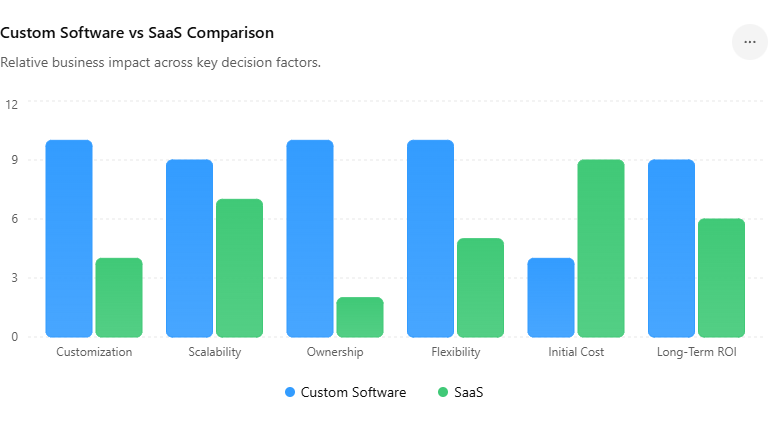
Custom Software vs SaaS Comparison
Relative business impact across key decision factors.
When Should You Choose SaaS?
SaaS is ideal when:
You need rapid deployment.
Your requirements are relatively standard.
Budget constraints are significant.
Internal technical resources are limited.
Time-to-market is critical.
When Should You Choose Custom Software?
Custom software is ideal when:
Business processes are unique.
Competitive differentiation is important.
Security requirements are complex.
Long-term scalability is a priority.
Multiple systems require integration.
Operational efficiency drives profitability.
Final Thoughts
The choice between Custom Software vs SaaS depends on your organization’s goals, budget, growth plans, and operational complexity. SaaS solutions offer speed and affordability, making them attractive for startups and businesses with standard requirements. However, custom software provides flexibility, ownership, scalability, and long-term value that can significantly enhance business performance.
For organizations focused on sustainable growth, operational excellence, and competitive advantage, the Custom Software vs SaaS decision often favors custom software as a strategic long-term investment. While SaaS serves as an excellent starting point, businesses seeking greater control and higher ROI frequently transition toward custom-built solutions as they scale.
Frequently Asked Questions
What is the difference between Custom Software and SaaS?
Custom software is built specifically for a business’s unique requirements, workflows, and goals. SaaS (Software as a Service) is a pre-built cloud-based application offered through a subscription model and designed for a broad range of users.
Which is more cost-effective: Custom Software or SaaS?
SaaS typically has lower upfront costs and faster deployment. However, custom software can provide better long-term ROI by eliminating recurring subscription fees and offering greater efficiency as the business grows.
Is Custom Software better than SaaS for growing businesses?
For businesses with unique processes, complex workflows, or long-term growth plans, custom software often provides better scalability, flexibility, and competitive advantages compared to SaaS solutions.
When should a business choose SaaS?
A business should choose SaaS when it needs a quick, affordable solution with standard features, minimal maintenance, and rapid implementation.
Which solution offers better scalability?
Custom software generally offers greater scalability because it can be expanded and modified according to evolving business needs. SaaS platforms may have limitations based on their predefined architecture and subscription plans.
What industries benefit most from Custom Software Development?
Industries such as healthcare, manufacturing, logistics, finance, retail, eCommerce, education, real estate, and enterprise services often benefit significantly from custom software solutions.
