

AI Agents vs Chatbots: What Is the Difference for Businesses?
- Author: Arun Kumar
- Posted On: April 10, 2026
- Post Comments: 0
| Getting your Trinity Audio player ready... |
Table of Contents
ToggleAI Agents vs Chatbots for Businesses: Key Differences, Benefits & Use Cases
Artificial intelligence is changing how businesses interact with customers, automate operations, and improve productivity. However, many companies still confuse AI agents and chatbots. While both technologies use AI to communicate with users, they serve very different business purposes.
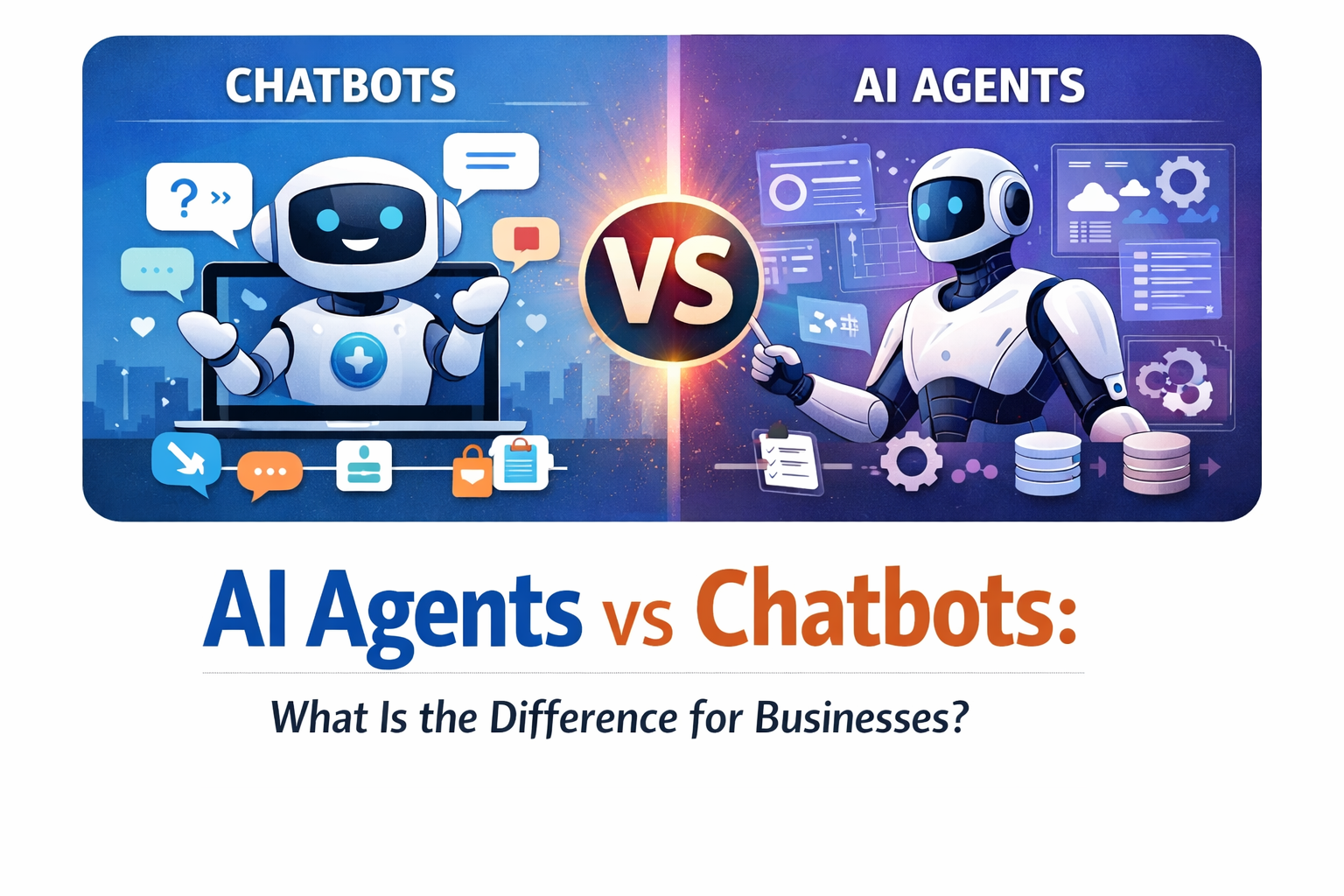
Traditional chatbots are designed to answer questions and guide users through simple conversations. AI agents go beyond that. They can make decisions, complete tasks, connect with business systems, and automate entire workflows.
As businesses look for smarter automation solutions in 2026, understanding the difference between AI agents and chatbots is essential for choosing the right technology. Searches for “AI agent” have increased rapidly as companies move beyond basic customer support bots toward systems that can act autonomously and improve business efficiency.
What Is a Chatbot?
A chatbot is a conversational software program that interacts with users through text or voice. Most chatbots follow predefined rules, decision trees, or keyword-based logic to respond to customer queries.
Businesses commonly use chatbots for:
Answering frequently asked questions
Booking appointments
Providing order updates
Collecting customer information
Routing conversations to human agents
Handling basic support requests
Chatbots are useful because they provide instant responses, reduce customer service workload, and are available 24/7. However, they usually struggle when conversations become complex or when users ask unexpected questions.
What Is an AI Agent?
An AI agent is a more advanced system that can reason, plan, learn, and take actions without constant human input. Unlike a chatbot, an AI agent does not simply respond to questions. It can perform tasks, connect with business software, analyze information, and complete workflows automatically.
Businesses use AI agents for:
Automating sales follow-ups
Managing customer service tickets
Generating reports
Updating CRM and ERP systems
Processing invoices and reimbursements
Scheduling meetings
Performing predictive analysis
Coordinating multiple business tasks
AI agents are powered by large language models, memory, integrations, and workflow automation tools. They are designed to act more like a digital employee than a simple conversation tool.
When Should Businesses Use Chatbots?
Chatbots are ideal for businesses that want to improve customer service without investing heavily in automation.
A chatbot is the right choice if your business needs:
FAQ support
Basic customer inquiries
Lead generation forms
Appointment booking
Order tracking
Website visitor engagement
Simple internal helpdesk support
For example, an e-commerce store can use a chatbot to answer questions about shipping, returns, and product availability. A healthcare clinic can use a chatbot to schedule appointments and remind patients about visits.
Chatbots are affordable, easy to implement, and effective for businesses with straightforward communication needs. However, they often hit limitations when users ask more detailed or unexpected questions. Many enterprises report that chatbots plateau because they cannot integrate deeply with business workflows or resolve complex tasks.
When Should Businesses Use AI Agents?
AI agents are better suited for businesses that need automation beyond conversation.
An AI agent is the right solution if your company wants to:
Automate repetitive workflows
Handle customer requests end-to-end
Improve employee productivity
Connect multiple business systems
Manage complex customer journeys
Provide personalized recommendations
Analyze data and generate insights
Reduce manual tasks across departments
For example, an AI agent in a sales department can qualify leads, send follow-up emails, schedule meetings, update the CRM, and generate sales reports automatically. In finance, AI agents can process invoices, detect anomalies, and manage reimbursements faster than manual workflows.
Research shows that agent-based systems can significantly reduce processing times and error rates in ERP and finance operations, making them valuable for modern enterprises.
Benefits of AI Agents for Businesses
Businesses are increasingly adopting AI agents because they offer more value than traditional chatbots.
Some major benefits include:
Better operational efficiency
Reduced labor costs
Faster response times
Improved customer experiences
Smarter decision-making
Higher scalability
Greater personalization
Seamless integration with existing tools
Industry experts predict that nearly half of enterprise applications will include task-specific AI agents in 2026. Businesses are moving from simple conversational tools to systems that can take action, solve problems, and support real business outcomes.
Challenges of AI Agents
Although AI agents are powerful, they are not perfect.
Businesses should consider challenges such as:
Higher implementation costs
Complex integrations
Data privacy concerns
Security risks
Need for ongoing monitoring
Risk of incorrect decisions or hallucinations
Dependence on high-quality business data
Experts warn that many AI agent projects may fail if businesses do not define clear goals, integrate properly, or manage risk effectively. Human oversight is still important, especially in sensitive industries such as healthcare, finance, and cybersecurity.
Which Is Better: AI Agent or Chatbot?
There is no single answer because it depends on your business needs.
Choose a chatbot if you want:
Quick deployment
Lower cost
Basic customer service
Simple conversational support
Choose an AI agent if you want:
End-to-end automation
Workflow management
Intelligent decision-making
Deeper business integration
Greater long-term efficiency
Many businesses use both technologies together. A chatbot can handle the initial customer conversation, while an AI agent works behind the scenes to complete tasks, update systems, and automate follow-ups.
Final Thoughts
The future of business automation is moving beyond simple chatbots. While chatbots remain useful for customer support and basic communication, AI agents are becoming essential for companies that want to automate operations, improve efficiency, and scale faster.
In simple terms, chatbots answer questions, while AI agents complete tasks. Businesses that understand this difference can choose the right solution for their goals and stay ahead in the rapidly evolving AI landscape.
