

Industries Transformed by Large Language Models (LLMs) in 2026 : Use Cases, Trends & Enterprise Impact
- Author: Princee Rithikka
- Posted On: June 18, 2024
- Post Comments: 0
| Getting your Trinity Audio player ready... |
Table of Contents
ToggleIndustries Transformed by Large Language Models (LLMs) in 2026: Use Cases, Trends & Enterprise Impact
Large Language Models (LLMs) have moved far beyond experimental AI tools. In 2026, they have become core enterprise infrastructure, reshaping how businesses operate, innovate, and compete. What started as conversational AI has evolved into intelligent systems capable of reasoning, summarization, automation, and decision support at scale.
Across industries, organizations are using LLMs to reduce operational costs, improve customer experiences, accelerate innovation, and unlock new revenue streams. From healthcare diagnostics and financial risk analysis to hyper-personalized marketing and autonomous software development, LLMs are redefining digital transformation.
This blog explores how industries are being transformed by Large Language Models in 2026, real-world use cases, and why enterprises are increasingly investing in custom LLM development and integration.
What Are Large Language Models (LLMs)?
Large Language Models are advanced AI systems trained on massive volumes of text, code, and structured data. Using deep learning and transformer architectures, LLMs understand context, intent, and language patterns to generate human-like responses.
Modern LLMs go beyond text generation. In 2026, enterprise-grade LLMs support:
Multimodal inputs (text, voice, images, documents)
Domain-specific reasoning
Secure private deployments
Integration with enterprise systems like ERP, CRM, and BI platforms
These capabilities make LLMs a powerful engine for business automation and intelligence.
Know more about Large Language Models and how they work
Why LLM Adoption Has Accelerated in 2026
Several factors are driving rapid LLM adoption across industries:
Maturity of Generative AI – Models are more accurate, explainable, and controllable.
Enterprise Security & Compliance – Private and on-premise LLMs reduce data risks.
Cost Optimization – Automation reduces dependency on manual workflows.
Competitive Pressure – Businesses adopting LLMs outperform slower competitors.
Integration with Business Systems – LLMs now work seamlessly with existing software.
Key Use Cases of Large Language Models Across Various Industries
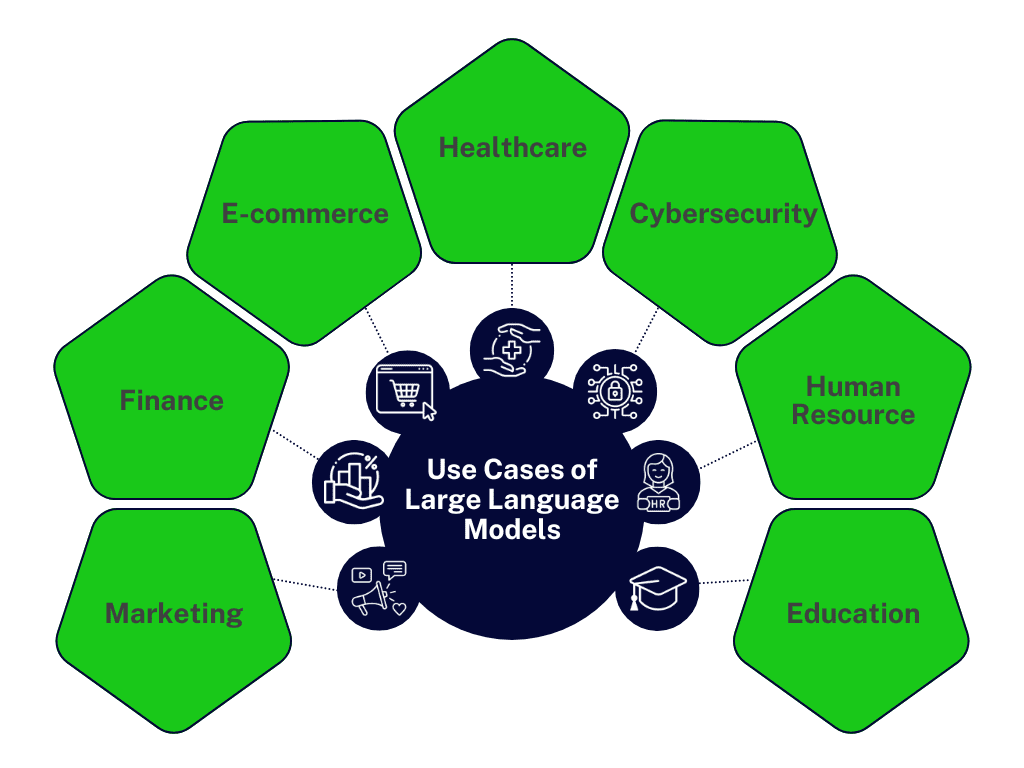
Marketing, Sales & Customer Experience
Marketing teams increasingly rely on LLMs to deliver data-driven, personalized engagement at scale.
Key Use Cases:
AI content generation for blogs, ads, and emails
Lead qualification and nurturing chatbots
Customer journey personalization
CRM intelligence and forecasting
Social media and campaign optimization
Business Impact:
Organizations achieve higher lead conversion rates, improved customer lifetime value, and more effective marketing campaigns.
Banking, Finance & Insurance
Financial institutions rely heavily on data, compliance, and customer trust. LLMs in 2026 play a critical role in improving efficiency while maintaining regulatory standards.
Key Use Cases:
AI-driven customer support and virtual assistants
Fraud detection and anomaly explanation
Financial report and audit summarization
Risk assessment and credit analysis
Regulatory and compliance automation
Business Impact:
Banks and insurers benefit from faster decision-making, enhanced compliance, and personalized financial services – all while reducing manual effort.
Retail & E-Commerce
Retailers are using LLMs to create deeply personalized shopping experiences and streamline backend operations.
Key Use Cases:
AI shopping assistants
Personalized product recommendations
Customer sentiment and review analysis
Dynamic pricing insights
Automated customer support across channels
Business Impact:
LLMs help increase conversion rates, improve customer retention, and optimize inventory management – directly impacting revenue growth.
Healthcare & Life Sciences
Healthcare has emerged as one of the most impactful adopters of LLM technology. In 2026, hospitals, clinics, and life sciences companies use LLMs to enhance both clinical and administrative operations.
Key Use Cases:
AI-powered clinical documentation and transcription
Intelligent patient support chatbots
Medical research summarization
Drug discovery insights and trial data analysis
Diagnostic assistance for clinicians
Business Impact:
LLMs significantly reduce administrative workload, improve accuracy in medical records, and help healthcare professionals focus more on patient care – leading to better outcomes and lower operational costs.
IT, SaaS & Software Development
LLMs have become indispensable tools for modern software teams.
Key Use Cases:
AI-powered code assistants
Automated testing and debugging
DevOps documentation and automation
Technical support chatbots
Knowledge management for engineering teams
Business Impact:
Faster development cycles, improved code quality, and reduced operational overhead.
Human Resources & Talent Management
HR teams leverage LLMs to enhance recruitment, onboarding, and employee engagement.
Key Use Cases:
Resume screening and candidate matching
AI-driven interview assistants
Employee policy Q&A systems
Training content generation
Performance feedback analysis
Business Impact:
LLMs streamline hiring, improve employee experience, and reduce HR operational costs.
Education & E-Learning
Education is undergoing a major transformation with AI-powered personalization. LLMs enable adaptive and inclusive learning experiences.
Key Use Cases:
AI tutors and learning assistants
Personalized learning paths
Automated grading and assessments
Course content generation
Student support chatbots
Business Impact:
Institutions improve student engagement, reduce faculty workload, and deliver scalable education experiences.
Legal & Professional Services
Law firms and consulting companies are adopting LLMs to manage vast volumes of documents and research efficiently.
Key Use Cases:
Contract analysis and summarization
Legal research automation
Compliance document generation
Case law insights
Knowledge base creation
Business Impact:
LLMs significantly reduce turnaround times, improve accuracy, and allow professionals to focus on strategic work rather than manual review.
Manufacturing & Supply Chain
Manufacturing organizations use LLMs to improve visibility, efficiency, and resilience in supply chain operations.
Key Use Cases:
Predictive maintenance insights
Supply chain demand forecasting
Automated procurement and compliance documentation
Knowledge management for operational teams
Vendor communication automation
Business Impact:
LLMs reduce downtime, improve planning accuracy, and streamline complex workflows across global supply chains.
Real Estate & Construction
In 2026, LLMs support smarter planning and customer interactions in real estate and construction.
Key Use Cases:
Property recommendation assistants
Contract and compliance documentation
Project planning insights
Customer inquiry automation
Market trend analysis
Business Impact:
Improved client engagement, better project visibility, and reduced documentation errors.
Enterprise Trends Shaping LLM Adoption in 2026
Custom LLM Development
Businesses increasingly prefer custom-trained LLMs tailored to their industry, data, and workflows.
Secure & Private Deployments
Data privacy concerns have led to greater demand for on-premise and private LLM solutions.
Multimodal AI
LLMs now process text, images, voice, and structured data – enabling richer use cases.
LLM + Automation
LLMs are being integrated with RPA and workflow automation tools to enable end-to-end process automation.
Why Choose a Custom LLM Development Company?
Off-the-shelf AI tools often fall short for enterprise needs. A professional LLM development company offers:
Domain-specific fine-tuning
Secure enterprise integration
Scalable architecture
Compliance-ready AI solutions
Measurable ROI
Custom LLM solutions ensure businesses gain maximum value while maintaining control over their data and workflows.
Conclusion
In 2026, Large Language Models are no longer optional – they are essential for staying competitive in a digital-first world. Industries across healthcare, finance, retail, manufacturing, and technology are using LLMs to automate operations, enhance customer experiences, and drive innovation.
Organizations that invest early in LLM integration and custom AI solutions position themselves for long-term success, agility, and growth.

Frequently Asked Questions: Large Language Models in 2026
Large Language Models (LLMs) are advanced AI systems trained on massive datasets to understand, generate, and analyze human language. In 2026, LLMs are widely used for enterprise automation, decision support, customer engagement, and content generation across industries.
Industries using Large Language Models the most in 2026 include healthcare, banking and finance, retail and eCommerce, manufacturing, education, legal services, marketing, SaaS, and human resources. These industries benefit from automation, personalization, and data-driven insights.
Businesses use LLMs for customer support chatbots, document summarization, content creation, fraud detection, personalized marketing, software development, and workflow automation. LLM applications in business help reduce costs, improve efficiency, and enhance customer experiences.
The key benefits of LLMs for enterprises include improved operational efficiency, faster decision-making, enhanced personalization, reduced manual workload, better knowledge management, and scalable automation across departments.
Yes, in 2026 many enterprises deploy private, on-premise, or custom Large Language Models to ensure data security and compliance. Secure LLM solutions help organizations meet regulatory requirements while maintaining full control over sensitive data.
Generative AI is a broader category that includes models capable of generating text, images, code, and audio. Large Language Models are a specific type of generative AI focused on understanding and generating human language for enterprise and consumer applications.
Explore Large Language Model Development at AppsInAi
Large Language Models are essential for improving efficiency, making smarter decisions, and fostering creativity in various industries. Many brands now use these advanced models daily to enhance performance. AppsInAi provides specialized LLM development services designed to meet your business needs and help your brand capitalize on these advancements.

Search
Categories
- AI Agents (5)
- AI and ML Development (8)
- AI Development (11)
- App development (10)
- App Maintenance (1)
- App Marketing (4)
- Artificial Intelligence (26)
- Big Data & Data Science (1)
- Blockchain (1)
- Case Studies (6)
- ChatGPT Development (2)
- Cost Estimation (1)
- Custom Software Development (5)
- Digital Signage (1)
- Generative ai (4)
- Internet of Things (IoT) (4)
- Large Language Model Development (1)
- Machine Learning (9)
- Mobile App Development (12)
- Object Recognition (1)
- Smart TV (2)
- Software Development (7)
- Web Development (1)
Tag Cloud
Recent Posts
- Best Dubai Taxi Apps: Easy, Fast & Reliable Ways to Get Around the City
- Machine Learning Solutions: Turning Business Data Into Intelligent Decisions
- AI Consulting Services: Building Smarter Strategies for Sustainable Business Growth
- AI ML Development Services: Architecture, Use Cases, Benefits, and ROI
- 10 Best Instant Loan Apps in the UAE 2026
Recent Comments